
Law, Tax Status and Insiders
The legal map, public charity versus private foundation, private inurement and private benefit, excess benefit transactions and the rebuttable presumption.
The advanced next step for nonprofit directors.

Go deeper on the law, money, risk and pressure situations nonprofit boards face: tax status and insiders, excess benefit rules, endowments and audit, Form 990 and fundraising law, executive pay and succession, lobbying limits, cybersecurity and AI, crisis, misconduct, and distress.
Nonprofit Board Governance is an advanced, self-paced online course for nonprofit directors. It is built for people who completed Nonprofit Board Fundamentals, for sitting directors, and for executive directors who work with boards. It goes deep on tax law, money, accountability, people, risk and crisis, and ends with a final exam. $697.
Nonprofit Board Governance is built for people who have completed Nonprofit Board Fundamentals, for sitting nonprofit directors, and for executive directors who work closely with their boards.
Every lesson ends with a short board exercise: a real decision you work through, so you practice the judgment a board seat demands. Enroll today.

Nonprofit Board Governance covers each of these issues in depth, so you can follow the conversation and ask better questions.
Deeper law, sharper oversight, and steadier judgment under pressure.
The legal map, public charity versus private foundation, private inurement and private benefit, excess benefit transactions and the rebuttable presumption.
Advanced financial statements, liquidity and reserves, signs of distress, endowments and UPMIFA, investment oversight, audits, internal control and fraud.
Form 990 as a governance record, fundraising law, gifts and restrictions, lobbying and the political campaign ban, enterprise risk, cybersecurity and AI.
Selecting and paying the chief executive, succession, culture and safeguarding, crisis, misconduct, distress, merger and dissolution.
You start from the fundamentals, watch 38 short video lessons and work a board exercise in each one, then take the final exam: 30 scenario questions, with 80 percent (24 correct) needed to pass. Passing earns a Certificate of Completion from Board Director Institute, which is not accreditation, licensure or a board appointment.
The course builds on Nonprofit Board Fundamentals, so you begin with a strong foundation.
Thirty-eight short video lessons, each ending with a board exercise and a PDF guide, plus a template pack.
Answer 30 scenario questions. You need 24 correct (80%) to pass, and retakes are allowed.
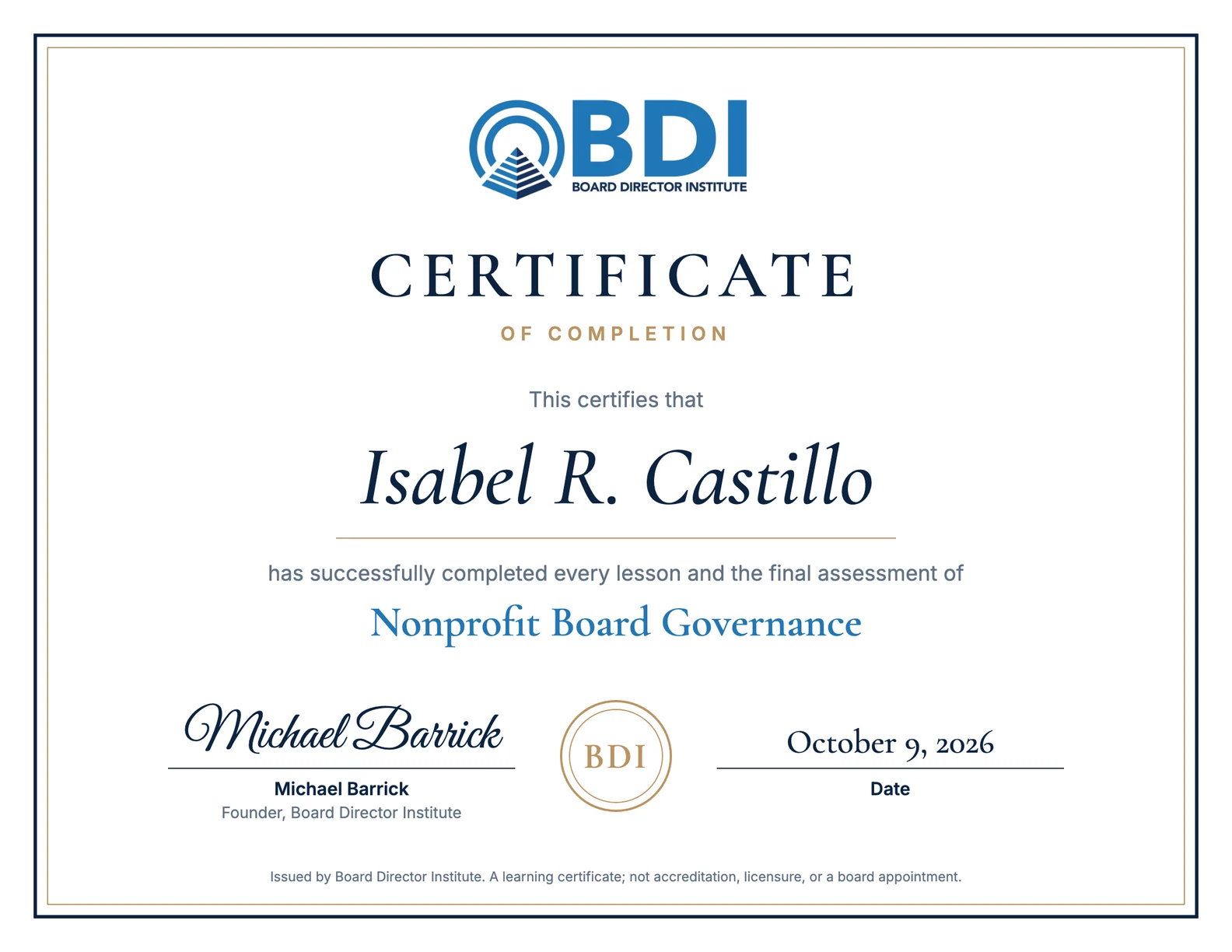
Receive a Board Director Institute Certificate of Completion for Nonprofit Board Governance.
Ready for the next step? Enroll today and go beyond the fundamentals.
Enroll todayThe course is built for people who have completed Nonprofit Board Fundamentals. Sitting nonprofit directors and executive directors who work with boards will also be at home here.
It focuses on the United States: state nonprofit corporation law, federal tax exemption with a 501(c)(3) focus, and state fundraising rules. Rules change, so check the current rule before you rely on it.
The final exam has 30 scenario questions. You need 24 correct answers (80%) to pass, and retakes are allowed.
No. The Certificate of Completion for Nonprofit Board Governance is issued by Board Director Institute. It records that you completed the required lessons and passed the final exam. It is not accreditation, professional certification, a license, or a board appointment.
Michael Barrick created the course. The video and voice in this course use an AI-generated version of Michael Barrick. Michael reviewed and approved the lesson content.
No. The course is general education. State law and your organization's own documents can change the answer, so consult a qualified adviser about your organization's facts and the law that applies to it.